

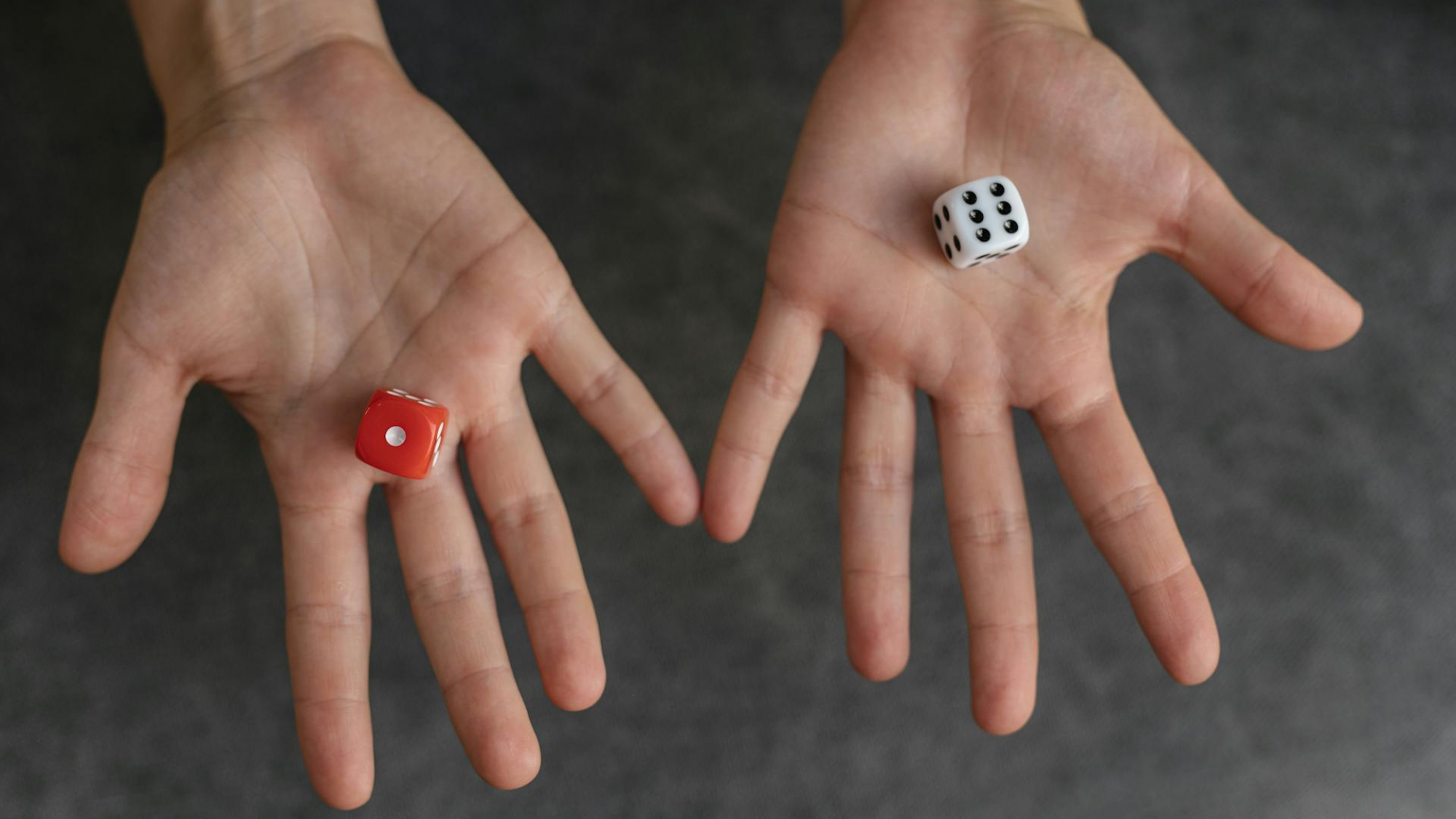
Every tabletop gamer eventually asks the same question mid-game: “what are the odds?” Should you risk the attack that needs a 15 on a d20, or play it safe? Is rolling 2d6 really different from one d12? Understanding dice probability turns luck into strategy — and it’s simpler than it looks. This guide breaks down dice notation, single vs multiple dice, and the famous 2d6 bell curve. For instant odds on any roll, use our free Dice Probability Calculator.
How to Read Dice Notation
Dice notation is the universal shorthand of tabletop gaming. It follows the pattern NdS+M:
N = how many dice you roll • d = just means “dice” • S = sides per die • +M = an optional number added to the total
So 1d20 is one twenty-sided die, 2d6 is two six-sided dice added together, and 3d8+5 is three eight-sided dice with 5 added on. Once you can read it, every RPG rulebook and character sheet makes more sense — and you can drop any of these straight into the calculator.
Single Die Odds: The Simple Case
One die is the easy part: every face is equally likely. On a fair d6, each number from 1 to 6 has exactly a 1-in-6 chance (16.67%). On a d20, each number is a flat 5%. The average roll of a single die is always halfway between 1 and its highest face — for a d6 that’s 3.5, and for a d20 it’s 10.5. This flat, even spread is called a uniform distribution.
Quick reference — single die
- d4: 25% each, average 2.5
- d6: 16.67% each, average 3.5
- d8: 12.5% each, average 4.5
- d10: 10% each, average 5.5
- d12: 8.33% each, average 6.5
- d20: 5% each, average 10.5
- d100: 1% each, average 50.5
Why 2d6 Beats 1d12: The Bell Curve
Here’s the most important idea in dice probability. A 1d12 and a 2d6 both produce totals in a similar range, but the shape of the odds is completely different. With one d12, every result is equally likely. With 2d6, the totals pile up in the middle: there’s only one way to roll a 2 (1+1) or a 12 (6+6), but six different ways to roll a 7 (1+6, 2+5, 3+4, 4+3, 5+2, 6+1).
That creates a bell curve — middle totals are common, extremes are rare. The practical takeaway: the more dice you add, the more results cluster toward the average. Rolling many dice is “swingier” toward the middle and more predictable; rolling one big die is pure flat chance. Game designers use this constantly to control how random a mechanic feels.
The 2d6 distribution every gamer should memorize
- 7 — 6 ways — 16.67% (most likely)
- 6 or 8 — 5 ways each — 13.89%
- 5 or 9 — 4 ways each — 11.11%
- 4 or 10 — 3 ways each — 8.33%
- 3 or 11 — 2 ways each — 5.56%
- 2 or 12 — 1 way each — 2.78% (rarest)
How to Calculate Dice Odds
For a single die, the chance of any number is just 1 divided by the number of sides. For multiple dice, you count every possible combination and group them by total:
Chance of a total = (ways to make that total) ÷ (total combinations)
The total number of combinations is sides raised to the power of dice. For 2d6 that’s 6² = 36 combinations; for 3d6 it’s 6³ = 216. To find the chance of rolling “at least” a number, you add up the ways for that total and every higher total. Our calculator does this exact counting for any roll — it’s true math, not a simulation, so the percentages are precise.
Worked example — rolling at least 15 on a d20
On a d20, the totals 15, 16, 17, 18, 19, and 20 all succeed — that’s 6 outcomes out of 20, so the chance is 6/20 = 30%. Need at least a 10? That’s 11 outcomes (10 through 20), or 55%. This is the everyday math behind every D&D attack roll.
Dice Odds in Popular Games
- Dungeons & Dragons: the d20 drives attacks and skill checks; knowing your hit chance against a target number is core strategy.
- Craps & Monopoly: built on 2d6, where 7 is the pivotal, most-common roll.
- Catan: resource numbers near 6 and 8 pay out far more often than 2 or 12 — the bell curve in action.
- Yahtzee & dice pools: probability tells you when to keep dice and when to reroll.
Frequently Asked Questions
What does 2d6 mean?
It means rolling two six-sided dice and adding them, for a total of 2 to 12. The 2 is the number of dice and the 6 is the sides. Seven is the most likely total.
What are the odds of rolling a 7 with two dice?
Six of the 36 possible combinations add up to 7, so the chance is 6/36 = 16.67% — the highest of any 2d6 total.
Is 2d6 the same as 1d12?
No. Both range similarly, but 1d12 is a flat, equal chance for every number, while 2d6 forms a bell curve where middle totals like 7 are far more likely than 2 or 12.
How do I read something like 3d8+2?
Roll three eight-sided dice, add them together, then add 2. The result ranges from 5 (three 1s plus 2) to 26 (three 8s plus 2), averaging 15.5.
Can a calculator predict my next roll?
No — each roll is independent and random. Probability tells you the long-run odds across many rolls, not the outcome of any single one. It's for strategy, not fortune-telling.
Calculate Any Dice Roll Instantly
Skip the combinatorics. Our free Dice Probability Calculator takes any notation like 2d6+3 or 4d8, then shows the chance of hitting a target, the average, the min and max, and the full probability distribution as a chart — all in your browser with no sign-up. Turn the results into clean percentages with our Percentage Calculator, optimize your team in the Palworld Breeding Calculator, or explore the full set of free online calculators.
More Free Calculators from BSM Sites
- Palworld Breeding Calculator
- Percentage Calculator
- GPA Calculator
- Grade Calculator
- Age Calculator
- Date Calculator
- Time Calculator
- Hours Calculator
- Water Intake Calculator
- BMI Calculator
- Body Fat Calculator
- Calorie Calculator
- TDEE Calculator
- BMR Calculator
- Macro Calculator
- Pace Calculator
- Ovulation Calculator
- Pregnancy Due Date Calculator
- Salary Calculator
- Net Worth Calculator
- Rent vs Buy Calculator
- Paycheck Calculator
- Mortgage Calculator
- Mortgage Payment Calculator
- Loan Calculator
- Loan EMI Calculator
- Compound Interest Calculator
- Debt Payoff Calculator
- Retirement Calculator
- Sales Tax Calculator
- Discount Calculator
- Tip Calculator
- Fuel Cost Calculator
- Square Footage Calculator
- Concrete Calculator
Add a Comment