

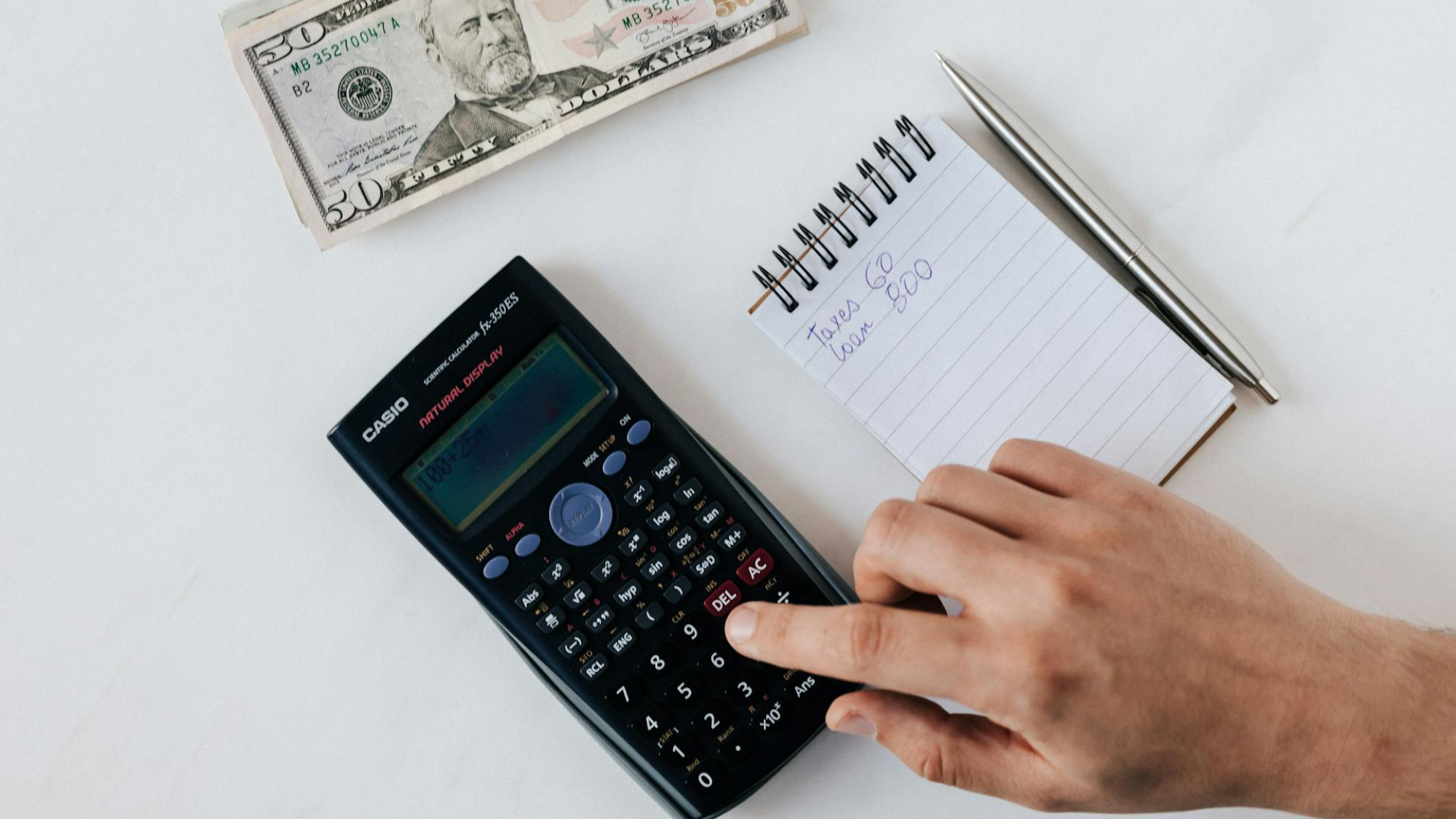
Sales are everywhere — Black Friday, Eid, end-of-season clearance, “extra 10% at checkout” — and the math is sneakier than it looks. A “20% off plus 10% off” sign sounds like 30% off, but it isn’t. This guide shows you exactly how to calculate any discount correctly, including the tricks stores use, how to reverse-engineer the real deal, and how to find your true out-the-door price once tax is added. When you want the numbers instantly, use our free Discount Calculator.
The Basic Discount Formula
Every discount calculation starts from one simple formula:
Sale Price = Original Price × (1 − Discount% ÷ 100)
And the amount you save is just the difference:
Amount Saved = Original Price − Sale Price
Example: a jacket priced at 120 with 25% off. The saving is 120 × 0.25 = 30, so you pay 120 − 30 = 90. That’s it — one multiplication and one subtraction. If percentages aren’t your strong suit, our Percentage Calculator breaks down the math step by step.
Stacked & Double Discounts: Why 20% + 10% Is Not 30%
This is the most common shopping-math mistake, and stores quietly benefit from it. When you combine a sale with a coupon, the second discount applies to the already-reduced price — not the original. The discounts multiply; they do not add.
Here’s the proof on a 100 item:
- 20% off 100 = 80
- Then 10% off 80 = 8 off, leaving 72
- Total saved = 28, so the real (effective) discount is 28%, not 30%
The shortcut: multiply what’s left after each discount. 0.80 × 0.90 = 0.72, meaning you pay 72% of the original. This is why a single flat “25% off” can beat a flashy “20% + 10%” stacked deal. Our discount calculator does this multiplicative math automatically and shows the true effective discount so you can compare offers fairly.
Reverse Discount: Find the Original Price (or the Real % Off)
Sometimes you only see the final number and want to check the deal. There are two reverse questions worth knowing.
1. What was the original price?
Original Price = Sale Price ÷ (1 − Discount% ÷ 100)
If you paid 90 after a 25% discount, the original was 90 ÷ 0.75 = 120. This is great for spotting inflated “was/now” pricing where the “original” price was never real.
2. What discount did I actually get?
Discount% = (Original − Sale) ÷ Original × 100
If the tag says 120 and you paid 90, that’s (120 − 90) ÷ 120 × 100 = 25% off. Switch the Discount Calculator to reverse mode and it solves either one instantly.
Out-the-Door Price: Adding Sales Tax, VAT & GST
The tag price is rarely what you actually hand over. In most U.S. retail and most VAT/GST countries, tax is applied after the discount, on the reduced price:
Out-the-Door = Sale Price × (1 + Tax% ÷ 100)
Example: an 80 sale price with 8% tax = 80 × 1.08 = 86.40. A few situations tax the original price instead, so our calculator lets you choose before or after to match your receipt exactly. Planning a bigger purchase? Pair this with your real income using the Paycheck Calculator so you know what fits your budget after taxes.
Mental Math Tricks for Discounts
You won’t always have your phone out in a store. These cover the most common sales:
- 10% off: move the decimal one place left. 10% of 85 = 8.50.
- 20% off: find 10% and double it. 20% of 85 = 17.
- 25% off: divide by 4. 25% of 80 = 20.
- 50% off: just halve it.
- 15% off: find 10%, then add half of that. 15% of 60 = 6 + 3 = 9.
Common Discount Types, Decoded
- Percentage off: the standard “% off the price.”
- Fixed amount off: a flat coupon like “10 off.”
- Stacked / double discount: coupon on top of a sale — multiplies, doesn’t add.
- BOGO (buy one get one): effectively up to 50% off across two items.
- 3-for-2: the cheapest item is free, roughly 33% off across the set.
- Clearance / markdown: a final price is set directly — reverse it to find the real % off.
Discount Shopping Around the World
The math is universal; only the currency and tax system change. In the US and Canada, prices are shown pre-tax and tax is added at checkout. In the UK and EU, displayed prices usually include VAT, so the sale price you see is what you pay. Australia and New Zealand include GST in the displayed price. In India and Pakistan, MRP-based pricing and category-specific GST mean it pays to check the receipt. Our Discount Calculator supports 25+ currencies so the numbers work wherever you shop.
Worked Example: A Real Black Friday Deal
Say a pair of headphones is listed at 200. There’s a 30% Black Friday sale, plus a 10% newsletter coupon, and your local sales tax is 7%.
- 30% off 200 = 140
- 10% off 140 = 126 (effective discount so far: 37%, not 40%)
- Add 7% tax: 126 × 1.07 = 134.82 out-the-door
You saved 74 off the tag price, an effective 37% discount. Notice how the “30 + 10” never reached 40% — that’s the multiplicative effect in action.
Frequently Asked Questions
How do I calculate a discount quickly?
Multiply the original price by the discount percentage to get your saving, then subtract it from the original. For 25% off 120: 120 × 0.25 = 30 saved, so the sale price is 90.
Is 20% off plus 10% off the same as 30% off?
No. Stacked discounts multiply: 0.80 × 0.90 = 0.72, which is 28% off — not 30%. The second discount applies to the already-reduced price.
How do I find the original price after a discount?
Divide the sale price by (1 minus the discount as a decimal). Paid 90 after 25% off? Original = 90 ÷ 0.75 = 120.
Is tax applied before or after the discount?
Usually after — on the discounted price — in most U.S. retail and most VAT/GST countries. A few cases tax the original price, so always check your receipt.
Calculate It Instantly
Skip the mental math when it matters. Our free Discount Calculator handles single, stacked, double, fixed-amount, and reverse discounts, adds tax for your true out-the-door price, supports 25+ currencies, and compares sale prices across discount levels — all in your browser, with no sign-up.
Add a Comment